
A 48V label does not prove that a battery will work with your solar inverter.
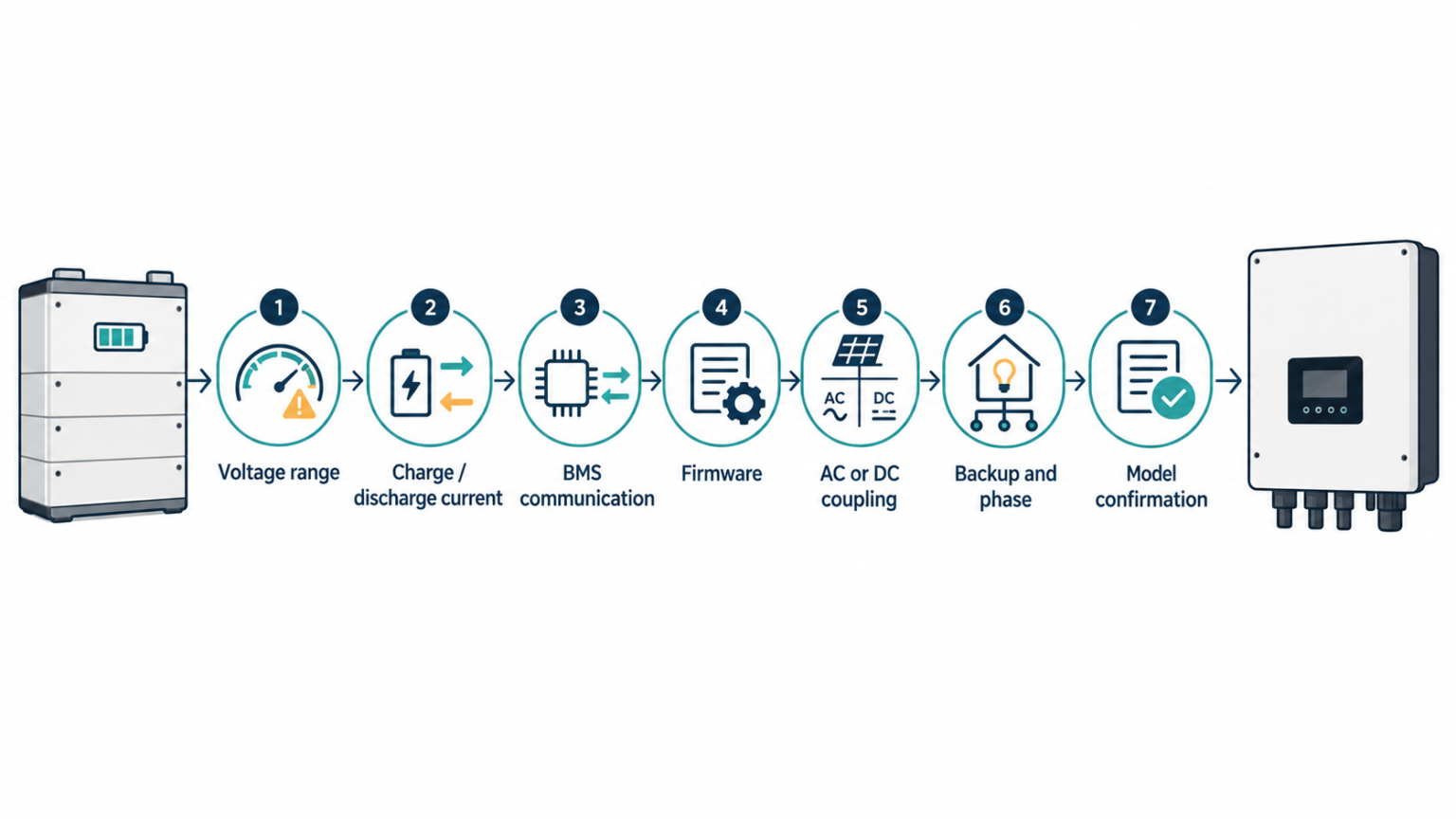
The real check includes the inverter’s voltage range, battery current limits, BMS communication, firmware and system architecture. Skip one of these, and the battery may refuse to charge, show a communication fault or fail to provide backup power.
Before ordering a retrofit battery, check the following seven points.
1. Compare the real voltage range
“48V” is a nominal value. A lithium battery may operate around 51.2V when fully charged and fall to a lower voltage during discharge.
Check the inverter’s minimum and maximum battery voltage, then compare those figures with the battery’s operating range. If the ranges do not overlap, the inverter may shut down or reject the battery. Do not match the products by the label alone.
2. Check continuous charge and discharge current
Capacity tells you how much energy the battery stores. It does not tell you how much power the battery can deliver.
For example, a 5kW inverter connected to a 51.2V battery may need roughly 5,000W ÷ 51.2V = 98A. That calculation does not include conversion losses or short periods of higher demand. If the battery can continuously discharge only 50A, the inverter cannot deliver its full rated output.
Confirm the battery’s continuous charge current, continuous discharge current and peak current before you compare capacities.
3. Confirm BMS communication
The battery management system, or BMS, monitors cell voltage, temperature and protection limits. It also tells the inverter whether charging and discharging are allowed.
Many systems use CAN or RS485. That does not make them automatically compatible. The protocol, communication speed, connector wiring and pinout may differ.
If the inverter cannot read the BMS data, it may limit the battery, display a fault or stop charging altogether. Use this battery and inverter compatibility guide when checking voltage, current and communication requirements together.
4. Check firmware and approved battery lists
Some inverters work only with specific battery models or firmware versions. A battery can have the correct voltage and a CAN port but still fail to communicate with an older inverter. The same issue appears when the inverter has not been updated to recognise a newer battery.
Ask for confirmation based on the exact battery model, inverter model and firmware version. “Compatible with 48V batteries” is not enough detail for a purchase decision.
5. Identify AC or DC coupling
The retrofit method depends on how the existing solar system is wired. An AC-coupled battery can sometimes be added to an existing solar inverter. A DC-coupled system may require a compatible hybrid inverter or a different wiring arrangement.
The installer also needs to check cable routes, protection devices, available space and local electrical requirements. A low-cost battery is not a low-cost retrofit if the rest of the system needs major changes.
6. Check backup and phase requirements
A system designed to reduce electricity bills may not support backup power during an outage.
Confirm which circuits need backup, whether the inverter can isolate the home from the grid and whether the system is single-phase or three-phase. These details affect the inverter, battery current, protection equipment and installation design.
For a three-phase property, confirm the backup arrangement before choosing the battery. Do not assume that a single-phase battery system can support the whole building.
7. Request model-level confirmation
Before paying a deposit, prepare a short compatibility sheet:
| Item | Information to confirm |
| Existing inverter | Brand and exact model |
| Battery | Model, usable capacity and voltage range |
| Current | Continuous charge and discharge limits |
| Communication | CAN or RS485 protocol and pinout |
| Firmware | Current version and approved battery list |
| Installation | AC/DC coupling, backup loads and phase |
Ask the supplier or installer to confirm the complete combination in writing.
A 48V battery may be electrically close to the right choice and still be the wrong battery for the inverter already installed. Check the model, protocol and operating limits before the order is placed. That short review is cheaper than replacing a battery that cannot communicate with the system.