
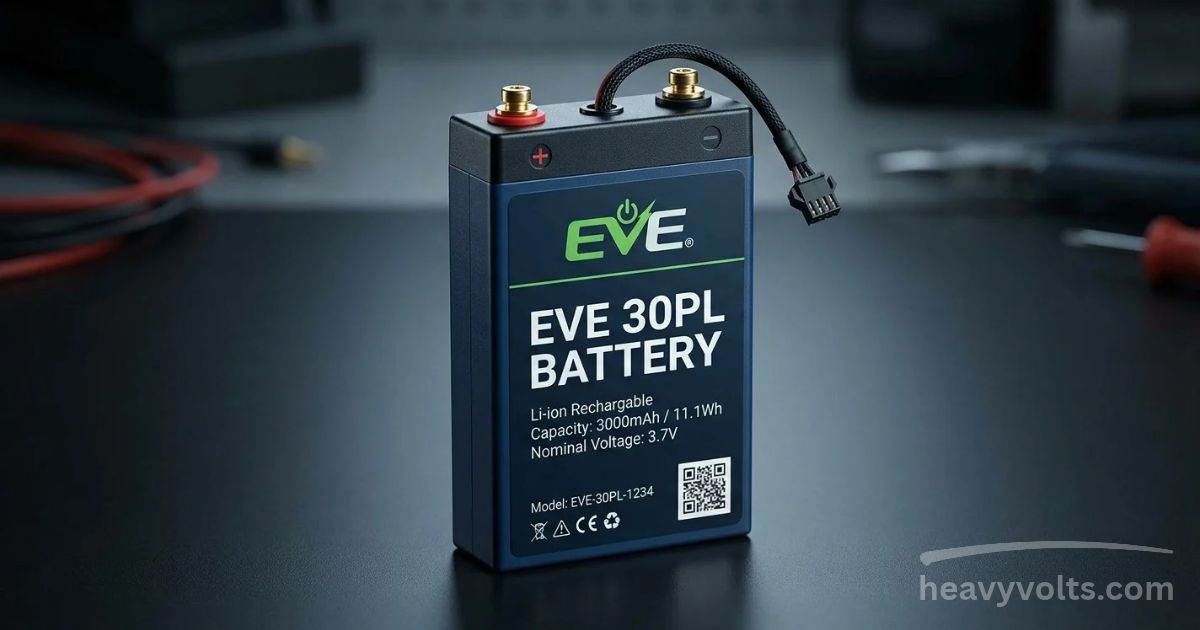
The EVE 30PL is a rechargeable cell that EVE Energy labels INR18650/30PL. It offers nominal capacity 3000mAh at nominal voltage 3.65V, with a temperature-limited 60A maximum discharge. Shoppers meet it as a 3000mAh 18650 cell, a 60A 18650 battery, or a tabless 18650.
EVE Energy began in 2001 in Huizhou, China, and makes cylindrical and prismatic cells, and About:Energy dates this model to 2025. Sellers also call it a flat-top 18650, an unprotected 18650 cell, or a high-drain 18650 battery, and each label describes a real trait. It belongs to the EVE P series, a cylindrical NCM cell family inside the wider 18650 lithium-ion battery category.
What Do the Core Specifications Say?
Three numbers define this cell: nominal capacity 3000mAh, nominal voltage 3.65V, and nominal energy 10.95Wh. The maximum charge voltage 4.2V caps the top end, while the discharge cut-off voltage 2.5V marks the bottom. EVEMall and DIY500AMP publish the same values.
Size and weight need a closer look. The cell diameter and height measure 18.35 mm by about 65 mm, although EVEMall states 65.00 mm and DIY500AMP states 65.15 mm. The cell weight 47g figure also differs, since DIY500AMP gives 45 g plus or minus 2 g, and About:Energy reports a cell volume of 17.4 cm³ beside energy density 233Wh/kg and power density 4,660W/kg.
How Should You Read the 60A Rating?
EVE specifies 60A as the maximum continuous discharge current, but only as a temperature-limited continuous rating that requires a published cutoff. The 75°C recommended cutoff and the 80°C maximum cell temperature define the boundary. Treat 60A as a ceiling, never as a daily target.
On a 3 Ah cell, 60A equals a 20C discharge rate, a figure About:Energy highlights. Convoy states 50A instead, so sellers disagree, and the cell temperature cutoff becomes the safer reference. Sustained current also depends on thermal management, because cooling decides how long the cell stays below 75°C.
What Sits Inside the Cell and Around It?
The EVE 30PL relies on lithium-ion chemistry, and EVE files it under NCM chemistry in its cylindrical cell range. About:Energy leaves the cathode and anode rows blank on its specification table, so none of these sources names the electrode materials. Check the datasheet before you quote material details.
The tabless electrode design removes the traditional tab, and IMR Batteries publishes an explainer on tabless lithium-ion cells. Outwardly, the cell has a flat-top positive terminal, and a PVC wrapper covers the cell casing. DIY500AMP tells buyers to reject cells with a missing insulator ring, and IMR adds the terminal insulator to its inspection list.
How Does the Cell Behave Under Load?
The datasheet gives AC internal resistance ≤6mΩ, and FlashlightGo says low internal resistance helps reduce voltage drop, which builders call voltage sag. DIY500AMP reviewers report voltage stability under load and cooler operation under load. Those reports come from customers, so read them as impressions, not guarantees.
Pulse behaviour differs from steady discharge. DIY500AMP’s search listing mentions a 140A burst current, yet its page keeps pulse power and over-current figures out of the ratings. Ask for a discharge curve from constant-current discharge tests, and note the charge temperature range of 0 to 45°C, the discharge temperature range of −20 to 60°C, and the wide temperature performance EVEMall advertises.
Where Does This Cell Work Best?
EVEMall lists power tools, garden tools, electric drills such as a cordless drill, a lawnmower, a vacuum cleaner, a sweeping robot, and other cleaning tools. DIY500AMP adds hobby and mobility uses to that group. Both sites tie the cell to equipment that draws heavy current.
Mobility appears on several sites: EVEMall names electric two-wheelers, DIY500AMP lists an e-bike among its best fits, and an electric scooter or light electric vehicle (LEV) pack follows the same logic. About:Energy points to aviation, motorsports, and drones, while DIY500AMP lists UAV use and its reviewers fly an FPV drone or an RC aircraft. Smaller jobs include portable energy storage, a high-output flashlight, or a compact tool battery, and electric mobility remains the broadest category.
What Should You Look for in a Service Provider?
A good provider publishes the manufacturer data sheet, states whether the cell carries protection, and explains return or warranty terms in plain words. Working contact details and a safety page should accompany those items. Together, those checks separate informed sellers from listings that only repeat a model number.
Start with the datasheet, because it lists standard charge current, maximum charge current, charge cutoff current, and cycle life. EVEMall quotes 1.25A standard, 14.5A fast charging, a 100mA cutoff, and 500 nominal cycles, while DIY500AMP and FlashlightGo quote 1.5A and 9A. Ask which datasheet revision the provider follows.
How Can You Spot Authentic Cells?
Look for sellers that name the exact model, explain CCC certification, and describe authentic cells with a stated grade. IMR Batteries advertises Grade A cells and publishes a CCC certification page plus an NDAA compliance guide, while DIY500AMP describes Grade A cells from trusted manufacturers. Those statements help, but never replace your own checks.
Counterfeit or knockoff cells cause real disappointment, so compare the measured capacity of delivered cells with the rating on a charger that logs milliamp-hours. One DIY500AMP reviewer reported identical resting voltage across a whole order, at 3.46V, which points to consistent batches. A forum thread whose title promises a bench test of this tabless cell with the CCC logo shows that buyers also compare notes in public.
Which Safety Details Should a Provider Publish?
Providers should publish lithium-ion battery safety warnings, mark the cell as not for vape devices, and explain thermal runaway. IMR Batteries and DIY500AMP both do this, and both tell buyers to use a protected pack. Missing warnings tell you the seller skipped the basics.
Sensible warnings also cover short circuit risk, overcharge, over-discharge, and over-current protection, and they tell you to use a smart charger with matching voltage. IMR repeats a loose battery warning, pushes a protective battery case for storage, and tells buyers to reject a damaged wrapper or a leaking or bulging cell. Its emergency note moves a failing cell onto a non-flammable surface and calls lithium-ion cell fires a Class B fire.
Which Brands Publish Information About This Cell?
This guide draws on Convoy, IMR Batteries, About:Energy, EVEMall, DIY500AMP, FlashlightGo, and a thread on e-cigarette-forum. Each brand offers the services listed on its own website, so confirm details there first. Only services that those sites confirm appear below.
The group includes consumer retailers, a battery modelling platform, and EVE’s own store, so services differ widely. About:Energy offers simulation access and datasheets rather than cells. Treat the forum thread as peer discussion, not a service.
What Do the Retailers Confirm?
Convoy, IMR Batteries, and FlashlightGo sell directly to individual buyers who order small quantities. Convoy lists WhatsApp, Telegram, and email contacts, IMR Batteries lists a phone line and Houston pickup, and FlashlightGo lists email support. Each also publishes shipping and return pages.
IMR Batteries adds a free battery case, a FindMyBattery selector, wholesale inquiries, and pages on battery recycling and maintenance, though its listing covers the EVE 30P rather than the 30PL. FlashlightGo allows seven-day returns, replaces defective or damaged items, and gives batteries a three-month warranty against one year for products. Convoy’s page links an akkutests.de review, which gives readers an independent battery test to read.
What Do the Builder and Engineering Sites Confirm?
DIY500AMP, EVEMall, and About:Energy serve builders and engineers more than casual buyers, and their pages carry deeper technical data. DIY500AMP offers builder support, custom battery inquiries, and cell test data through BatteryRealData. EVEMall offers online consultation and trade contact, and About:Energy offers modelling tools.
EVEMall also quotes customization for assemblies, wire leads, terminals, and tabs at a minimum order of 5,000 units, so it targets manufacturers more than hobbyists. About:Energy’s Voltt platform offers battery modelling, a degradation model, and drive cycle simulation, and it cites McMurtry Automotive as a case study. EVEMall describes the cell as explosion-proof and leakage-free, and it cites an environmental management certification.
How Do You Build or Rebuild a Pack?
Start with a battery management system (BMS) or protection circuit board (PCB), because an unprotected 18650 cell carries no protection of its own. A DIY battery pack and a custom battery pack both need that protection layer. A tool battery rebuild or a plain cell replacement follows the same rule.
Builders join cells by spot welding, so a spot welder and a nickel strip or copper strip become basic kit, and IMR and DIY500AMP both repeat the do not solder to cell rule. Good packs use cell matching inside balanced parallel groups, a series and parallel configuration that the BMS can read, and checks for current sharing. Cell spacers, fish paper, Kapton tape, and a battery case finish the build, while the do not mix cells rule applies to different ages and charge levels.
How Does the Cell Compare With Other Cells?
About:Energy compares it with the Molicel P30B, the Molicel P30S, and the LG Chem MJ1. The P30B matches the 3 Ah capacity at 30A, the P30S reaches 54A, and the MJ1 offers 3.5 Ah at 10A. Those three comparisons show where the 30PL sits.
The EVE 30P drops to 30A on IMR’s page, while the EVE 40PL and EVE 50PL extend the family to 21700 cells at 4000mAh and 5000mAh on EVEMall. IMR’s brand menu covers Samsung, Sony Murata, Panasonic, Molicel, BAK, Efest, and Ampace, and DIY500AMP lists an Ampace JP30 as a 3000mAh alternative. EVE Energy builds a high-power cell like the 30PL and an energy-led cell on shared production lines, so check which variant a listing names.
Why Use This Website to Find a Provider?
This website gathers the checks above in one place, so you compare providers on facts instead of opening seven separate tabs. It points you to sellers, data sources, and builder services for the EVE 30PL, each with the services its own site confirms. You still confirm details on each brand’s own site.
Searching alone takes longer than it should because the numbers differ: 50A on one page and 60A on others, 47 g against 45 g, and 65.00 mm against 65.15 mm. This site lays those differences side by side and shows what each provider confirms. A habit worth building: write down your load current, pack voltage, and protection plan before you contact any provider.
What Do Buyers Ask Most About the EVE 30PL?
Can You Use It in a Vape?
No. IMR Batteries and DIY500AMP both say the cell does not belong in e-cigarettes or vape devices, and DIY500AMP files vaping under the uses to avoid. Reviews on other listings mention vapes, but seller warnings outweigh casual reviews, so seek vape-specific guidance elsewhere.
How Do You Charge It?
Use a smart charger that follows CC/CV charging up to 4.2V and stops at the cutoff current in the datasheet. DIY500AMP lists 1.5A as the standard current and EVEMall lists 1.25A, so confirm which value your datasheet gives. IMR also says never to leave a charging cell unattended.
How Should You Store and Move It?
Follow safe storage and safe transport habits: keep each cell in a case, away from keys and coins, in a cool and dry place. EVEMall lists low self-discharge among the cell’s features, which means a stored cell loses charge slowly. Check a stored cell’s voltage before use.
How Long Does the Cell Last?
EVEMall lists 500 nominal cycles, while DIY500AMP states 500 cycles to at least 60% of initial capacity at 6A charge and 30A discharge. Your own result depends on current, heat, and charging habits. Lower currents and cooler cells usually extend service life.
Where Should You Go Next?
For the EVE 30PL 18650 3000mAh 60A Li-ion Battery, start with this website’s provider guide and work through the checks above. Compare the datasheet, authenticity, safety pages, and services side by side, and note which provider answers your questions clearly. Then confirm the details on each brand’s own website before you order.