
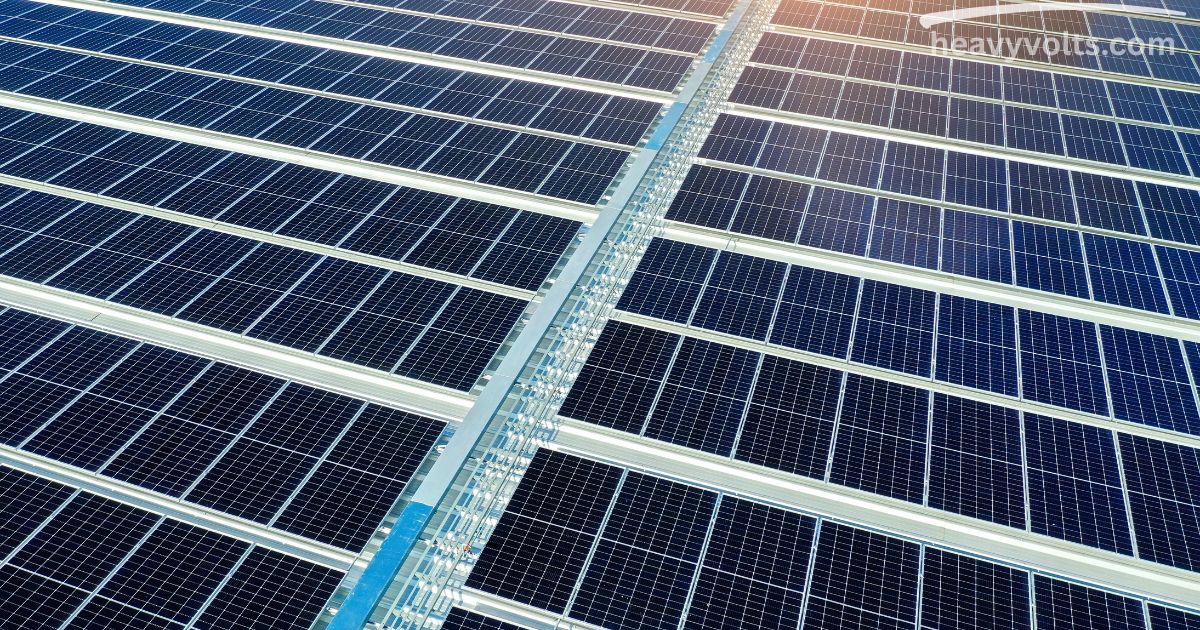
The solar cells in your neighbour’s roof panel are not magic; they are a nonmechanical device built to catch sunlight and turn it into usable power. Inside each one sits a semiconductor material, usually treated with boron on one side and phosphorus on the other, so it forms p-type silicon and n-type silicon layers that push electrons toward a hole left behind in the atomic structure.
When photons from the solar spectrum strike the surface, they reflect off some spots, but the ones that get absorbed knock free electrons loose, and these electrons migrate toward the front, creating a positive charge on one side and a negative charge on the other. This is the photovoltaic effect at work, and it is different from photovoltaic thermal cells, or PVT, which are built for water heating rather than electricity.
Because the sun sends down electricity for free every single day, solar farms and rooftop solar panels are becoming one of the most trusted paths toward a genuine renewable energy source, cutting carbon emissions and easing our grip on fossil fuels.
How Solar Cells Work
I have spent time watching engineers explain this at trade shows, and it always comes back to one simple picture: a junction where the n-type layer and the p-type layer meet.
On one side, phosphorus leaves extra electrons waiting around, and on the other, boron and traces of gallium leave open holes; where they meet, an internal electric field forms inside what is called the depletion zone, and this field keeps negatively charged ions on one edge and positively charged ions on the other from mixing freely.
Once photons land on the semiconductor material, energy passes into atoms, freeing dislodged electrons and creating electron-hole pairs through excitons, or sometimes as unbound electron-hole pairs and plasmons; the field then pulls them apart in a step called separation of charge carriers, before electrical conductors pick them up during extraction of charge carriers and send them out through an external circuit.
That flow builds an imbalance of electrical charge across the silicon wafer, producing a voltage potential much like the positive terminal and negative terminal of a household battery, and this is exactly the small DC electricity that once powered simple calculators and wristwatches long before it powered homes.
Components of a Solar Cell
Underneath the glass, a working cell is really a stack of small parts doing one job together. The semiconductor material, almost always silicon, carries phosphorus doping on the n-type layer and boron doping on the p-type layer, and this pairing is what sets up the electric field at the junction in the first place.
On top sits a thin anti-reflective coating that stops sunlight from bouncing away, while metal contacts collect the electric current; the front contact uses a grid pattern so light can still pass through, and the back contact covers the full surface to gather every last bit of charge. Premium versions swap in gallium arsenide, known as GaAs, because its favourable band gap cuts energy loss, though the cost keeps it mostly reserved for space-based applications in solar power technology.
Materials Found in Solar Cells / What Solar Panels Are Made Of
Not every panel is built the same way, and the differences show the moment you look closely. Monocrystalline cells come from single crystalline silicon and carry a uniform colour, often black or dark blue, cut into a square shape with rounded corners from cylindrical silicon ingots, giving them the highest efficiency of the group. telluride, copper indium gallium selenide, or organic PV cells, run between 7% and 13% efficiency, making them the cheapest option but also the least efficient.
A finished panel leans on silicon photovoltaic cells for 95% of its build, since silicon is the second most abundant material on Earth, arranged in a matrix-like structure behind a glass sheet that makes up 76% glass, roughly 3–4 millimetres thick, giving insulation against heat loss and humidity; a back sheet, a metal frame holding 8% aluminium at the right mounting angle, a 12V wire feeding the DC cabling to the inverter, a bus wire for soldering cells together, plastic polymer at 10%, copper at 5%, and silver at under 0.1%, alongside boron and phosphorous, round out the build.
How Solar Cells Are Made
The process starts far from anything resembling a finished panel. Workers feed silicon dioxide into an electric arc furnace, apply a carbon arc to strip away oxygen, and end up with carbon dioxide and molten silicon carrying only 1% impurity, before the floating zone technique passes an impure silicon rod through a heated zone again and again until it is pure enough.
the Czochralski method dips a seed crystal into melted polycrystalline silicon to pull out a cylindrical ingot, which a diamond saw or circular saw slices into silicon wafers, sometimes shaped as rectangular or hexagonal pieces instead of round ones, then smoothed by polishing unless the saw marks are left on purpose to trap more light.
Doping follows, either through a particle accelerator firing phosphorous ions to control ion penetration depth, or the older method of boron introduction; then electrical contacts made from palladium or copper are vacuum evaporated through a photoresist, sometimes over wax, and linked with tin-coated copper strips.
Finally, an anti-reflective coating of titanium dioxide or silicon oxide goes on through sputtering under high voltage at the electrode, and the cell is sealed in encapsulation using silicon rubber or ethylene vinyl acetate, framed in aluminium, backed with Mylar or Tedlar back-sheet, and topped with a glass cover or plastic cover to stop the 35 percent reflection silicon would otherwise waste.
How Are Solar Panels Manufactured
Once the cells exist, building a full panel is its own separate craft. Manufacturers line up monocrystalline silicon or polycrystalline silicon cells made from crystalline silicon, gallium, and boron into a silicon ingot, then slice thin sheets, add an anti-reflective layer, and cut narrow slits to guide current, before soldering everything with metal connectors into either 60-cell panels for homes or 72-cell panels for commercial projects.
A back sheet made from ultra-durable plastic protects the underside, a front glass layer filters sunlight in, and ethylene vinyl acetate glue bonds it all inside a metal frame fitted with mounting clamps.
A junction box then shields the wiring protection and stops any reverse current from draining the system through the inverter, and every finished panel goes through Standard Test Conditions, or STC, including electroluminescence imaging and performance tests on a flash tester set to 1000W/m2 irradiance, 25°C cell temperature, and air mass 1.5g, before it clears shipment and installation.
Types of Solar Panels
Choosing a panel usually comes down to three real options. Monocrystalline panels, cut from a single pure silicon crystal, are the most efficient and the most expensive, wearing a sleek black appearance that still delivers high performance even in low-light conditions. Polycrystalline panels, formed from multiple silicon crystals, are more affordable, carry a blue appearance from their multifaceted structure, and strike a fair cost-efficiency balance somewhere between 18–24% and 15–18% ranges.
Thin-film panels are the most versatile, made through photovoltaic material deposition onto glass surface or metal surface, staying flexible and lightweight at the least expensive end, though their lowest efficiency, near 10–13%, means the right pick really depends on budget, space availability, and energy needs.
History of Solar Energy / History of PV Systems
People used the sun long before anyone understood why it worked. In ancient times, communities relied on sunlight for fire, but the real turning point came in 1839, when French physicist Alexandre Edmond Becquerel made the photovoltaic effect discovery; decades later, in the 19th century, Charles Fritts built the first solar cell from gold and selenium. Silicon solar cells arrived in the 1950s, specifically 1954, thanks to Bell Telephone researchers, and through the late 1950s they powered U.S.
space satellites before reaching remote locations and off-grid communities that had no electric power lines; the energy crises of the 1970s then pushed governments to invest further. By 2004, most grid-connected PV systems in the United States were tied to the main grid, helped along by tax credits, net metering, and other financial incentives and government policies through the mid-1990s, and utility-scale power plants with at least 1 megawatt of capacity grew output from 6 million kilowatthours in that year to about 162 billion kWh, or 161,651,000 MWh, by 2023; small-scale PV systems, sometimes called rooftop PV systems, added 74 billion kWh, or 73,619,000 MWh, up from 11 billion kWh, or 11,233,000 MWh, in 2014, cementing solar’s place in the wider renewable energy landscape.
PV Cells, Panels, and Arrays
A single cell can only do so much on its own. Ranging from 0.5 inches to 4.0 inches across, one cell is the basic building block of any system, yet it produces just 1 or 2 Watts, barely enough for calculators or wristwatches.
Wired together, cells form a weather-tight PV panel, or module, and its electricity-generating capacity grows with surface area, while grouping panels further creates a PV array, anywhere from two PV panels to hundreds of PV panels.
Because panels naturally make direct current, or DC electricity, systems store it in batteries or run it through inverters to become alternating current, or AC electricity; expensive tracking systems can angle panels toward the sun, but most stay in a fixed position, facing south in the northern hemisphere or north in the southern hemisphere at an optimized angle, feeding anything from water pumps to utility-scale electricity generation, according to data from the National Renewable Energy Laboratory.
PV System Efficiency
Efficiency is where the technology has changed the most Experimental PV cells built for niche markets like space satellites have hit nearly 50% efficiency, while typical domestic solar panels capture roughly 20% conversion, and specialised multi-junction laboratory cells or space-grade cells can reach up to 40% efficiency; you can check any panel’s output by dividing panel power by panel area, and steady research and development keeps driving cost reduction across the board.
PV System Applications
Solar power earns its keep in more places than a rooftop. Systems can run water pumps directly or feed into electric power grids, and when the sun goes down, battery charging keeps power flowing to individual devices and single homes. Because panels work even where electricity distribution systems and power lines never reached, they allow quick installation with minimal environmental effects on buildings, supporting both off-grid supply and grid-connected supply at once.
Frequently Asked Questions
Solar cells for sale
Shopping around before you buy pays off every time. Comparing prices from local solar panel installers usually starts with a simple postcode search that returns several quotes from local professionals, letting you weigh monocrystalline panels, polycrystalline panels, and thin-film panels side by side. Whether you need residential installation or commercial installation, getting more than one quote is the safest way to avoid overpaying.
Solar cells vs solar panels
People mix these two up constantly, but the difference is straightforward. A photovoltaic cell is the individual unit that actually generates power, while a solar panel, or module, is a group of those cells wired together as a building block inside a weatherproof array. This electrically connected cells setup is what determines a system’s real electricity-generating capacity across its total surface area.
Photovoltaic cells price
Cost tracks efficiency fairly closely in this market. Monocrystalline cost sits at the top because of superior output, polycrystalline cost lands in the middle offering a solid cost-efficiency balance, and thin-film cost stays lowest as the cheapest option, though quality still varies with your budget. Buyers comparing domestic models against commercial models will notice the most expensive options aren’t always the mid-range price ones either.
What are solar cells made of ?
At the core sits one main ingredient doing most of the work. Silicon serves as the primary semiconductor material, split into p-type silicon and n-type silicon through boron and phosphorus, with pricier builds sometimes swapping in gallium arsenide for better performance. Around that core, a glass sheet, metal frame, copper, silver, plastic polymer, and bus wire or 12V wire complete the finished product.
Types of solar cells ?
Three main families cover almost every panel on the market today. Monocrystalline cells lead on efficiency, polycrystalline cells offer a balanced middle ground, and thin-film options built from amorphous silicon, cadmium telluride, copper indium gallium selenide, or organic PV cells trade some power output for flexibility and lower cost.
What is Solar cell symbol ?
Reading a wiring diagram gets easier once you know the shape to look for. On a circuit diagram, the standard electrical symbol for a photovoltaic cell representation shows a simple schematic with a clear positive terminal and negative terminal, plus an arrow marking current direction so installers can wire everything correctly the first time.
Theory of photovoltaic cells
Underneath the hardware is a fairly elegant piece of physics. The photovoltaic effect rests on semiconductor physics at the p-n junction, where sunlight generates electron-hole pairs that the depletion zone and its internal electric field pull apart into a usable flow of charge carriers, a process shaped heavily by each material’s band gap.
Solar cell size
Physical dimensions vary more than most people expect. Individual cells typically range from 0.5 inches to 4.0 inches across, measured by wafer diameter, and get grouped into a 60-cell panel or 72-cell panel depending on the module dimensions needed, with overall array size scaling up from there for larger installations.