
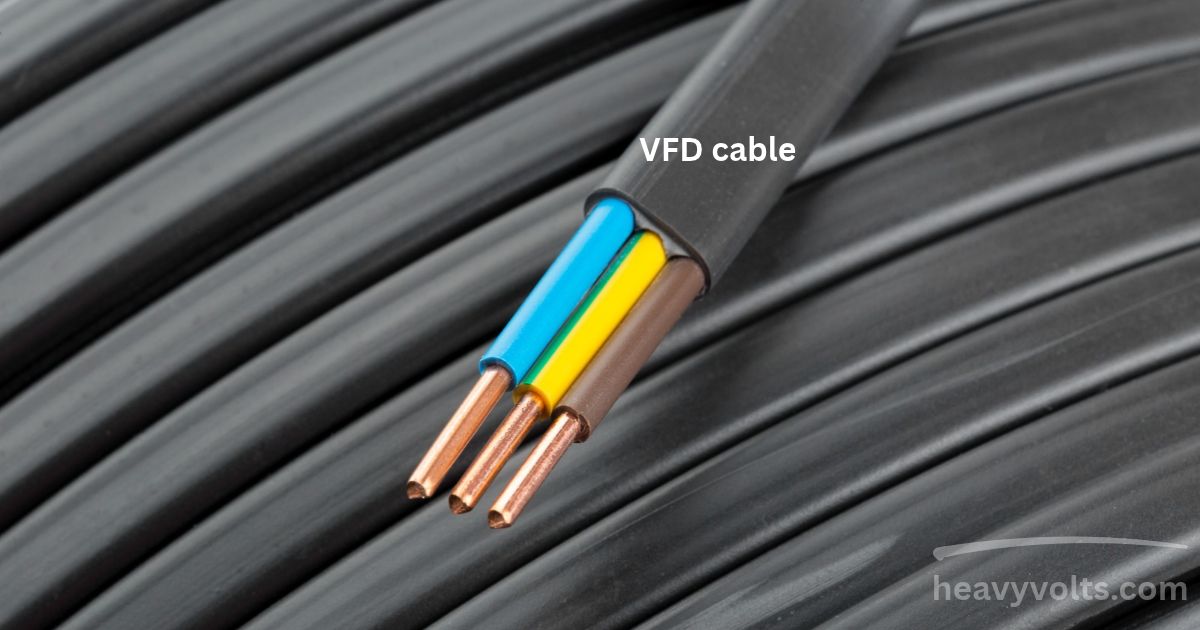
A VFD cable is a shielded power cable that links a drive to a motor, and engineers also call it a VFD power cable or VFD motor cable. It carries the drive’s fast switched output while it contains the noise that output creates, so nearby sensors and controllers keep working normally. Texas plants rely on it because a standard cable often fails under that stress.
Shops use many names for the same job, including variable frequency drive (VFD) cable, variable-speed drive cable, adjustable-speed drive cable, and AC drive system wiring. Each name describes the motor-to-drive connection that feeds an AC motor, and listings add VFD-motor cabling, shielded VFD cable, multi-conductor VFD cable, flexible motor supply cable, and VFD cable with signal pair. I have watched buyers search five of these names before they found one datasheet.
What Electrical Problems Does a VFD Cable Prevent?
A VFD cable prevents high voltage spikes, electromagnetic interference (EMI), and radio frequency interference (RFI) from damaging your motor or nearby controls. The drive switches very fast, and that switching creates EMI/RFI noise along the whole run. A properly built cable keeps that electrical noise inside its shield.
Long runs add standing waves, which push the voltage at the motor above the drive’s output, and corona discharge, which slowly erodes insulation. Common mode noise drives common mode current (CMC) through the motor shaft, and that current causes bearing fluting damage. Each failure shortens motor life, raises cable failure risk, and brings unplanned downtime under harsh operating conditions.
Which Cable Properties Control Performance?
Capacitance, impedance, and dielectric characteristics control how a cable behaves with fast pulses. A low-capacitance design reduces charging current and supports better power transfer efficiency. You should also read the insulation resistance figure on the datasheet.
I compare these numbers first because they predict heating and noise better than conductor size alone. Distributors list them in different units, so I convert everything to one unit before I rank the options. A cable with weak dielectric characteristics can pass a bench test and still fail after one hot season.
What Is Inside a VFD Cable?
Most VFD cables combine insulated phase conductors, a shield, grounds, and an outer jacket. A stranded conductor bends more easily than a solid one, and a tinned copper conductor or bare copper conductor suits different environments. XLPE (cross-linked polyethylene) insulation often surrounds each phase conductor.
Thin-walled XLPE keeps the diameter small, and RHW-2 insulation appears on many motor-supply listings. Some products use semiconductive “Surge Guard” insulation to ease voltage stress, and others offer a reduced-diameter cable for tight panels. I check the nominal outside diameter before I order any conduit fittings.
Which Jacket Materials Should You Compare?
Pick the jacket for the place the cable runs, because a PVC jacket suits general plant floors, a TPE (thermoplastic elastomer) jacket suits moving equipment, and an LSZH (low smoke zero halogen) jacket suits enclosed spaces. Outdoor and process areas call for a sunlight-resistant jacket, an oil-resistant jacket, or a UV-resistant jacket. A nylon jacket adds abrasion resistance where the cable drags across metal.
Texas sun degrades unprotected plastic faster than most buyers expect. Oil mist in a pump room can swell the wrong compound over time, and swollen jackets lose their grip inside glands. Where forklifts or falling tools threaten the run, an armored cable with continuously corrugated welded armor, tinned copper armor, or an armored and sheathed build adds protection.
Which Shield and Ground Designs Should You Compare?
Shield and ground design decides how well a cable contains noise. Options include a foil tape shield, triple-layer foil tape, copper tape shield, aluminum foil-polyester tape, Duofoil shield, braid shield, tinned copper braid, and spiral copper tape shield. Combination shields usually cover both low and high frequencies better than a single layer.
A drain wire helps you terminate the shield, and a barrier tape separates the layers. For grounds, compare symmetrical grounds, three symmetrical bare grounds, three symmetrical insulated grounds, and a full-size ground conductor, while a green/yellow ground makes inspection easier. A brake pair carries dynamic braking connections when the drive needs them.
Which Ratings and Standards Should You Check?
Check voltage, conductor size, and listings first. Common voltage ratings include 600V, 600/1000V, 2000V (2 kV), 8 kV, and 15 kV, and the higher tiers belong to medium voltage cable. Always match the voltage level to your drive output.
Conductor sizes appear in AWG or kcmil, and layouts come as 3-conductor or 4-conductor. Listings cite UL Type TC-ER, tray cable (exposed run), UL 1277, UL 2277, UL 1063, UL Type Motor Supply, UL WTTC, XHHW-2, and NEC Article 336, along with CSA approved, CE approved, and RoHS compliant marks. Many products carry a 90°C wet or dry rating, and I read every listing line rather than trust the product title.
How Do You Read a VFD Cable Datasheet?
Read the datasheet from the top: construction, ratings, then dimensions. Confirm that the voltage level, the AWG or kcmil size, and the 90°C wet or dry rating match your order. Then check the listed UL Type Motor Supply or UL Type TC-ER mark against your installation method.
Dimensions come last but cause the most surprises on site. A nominal outside diameter that exceeds the gland range forces a second order, and a stiff jacket makes tight bends harder in a crowded panel. I keep a short checklist of these fields and tick each one before I approve a purchase.
Where Do Texas Industries Use VFD Cables?
Texas industries use VFD cables wherever motors need speed control, from oil and gas to water and wastewater. Plants in Houston and Dallas run them on pumps, fans, compressors, and conveyors. Demand follows industrial motion control and commercial flow and pumping.
Other uses include extrusion, commercial HVAC, industrial automation, refinery and petrochemical units, offshore platform and onshore sites, power and utility stations, and food and beverage lines. Further sectors include pulp and paper, metals and minerals, material handling, packaging equipment, renewable energy, data centers, mining, alternative fuel, and transportation. Buyers also value Texas distribution, because local stock shortens lead times for each of these sectors.
How Do You Select and Install the Right VFD Cable?
Start with the drive rating, the motor load, and the cable run length, then match the shield and insulation to them. Follow a VFD cable selection guide to narrow the list quickly. The goal is selecting the right VFD cable once instead of replacing it later.
Distance matters, so check cable installation distance limits before you buy, and choose continuous flex and better flexibility where the cable moves. Good installation practices include a proper grounding system, correct cable termination, conduit or cable tray support, and a shielding types comparison before purchase. Use VFD cable glands with cable gland accessories, add strain relief / cord grips, and choose an explosion-proof cable gland in hazardous areas.
Is an Unshielded Cable Still Acceptable?
Some older plants still run an unshielded tray cable (legacy method) between the drive and the motor. Modern drives switch faster, so that approach leaves noise uncontained and sends it into nearby signal wiring. Treat it as a retrofit target and schedule the change during the next planned outage.
Replacing it brings improved safety, increased reliability, reduced maintenance, and better equipment protection. I put motors with repeated bearing failures at the top of every retrofit list. Those motors show the cost of a weak cable first.
How Do You Test a Cable After Installation?
Test the cable after installation and before you start the drive under load. Check shield continuity, ground connection, and insulation resistance with the instrument your plant procedure requires. Record each reading so later technicians can compare against it.
Early readings give you a baseline that costs almost nothing. If a reading drifts months later, you know the cable or its cable termination changed. I once traced a recurring drive trip to a loose shield connection at the drive end, and a fresh termination fixed it.
Which Brands Supply VFD Cable in Texas, and What Services Do They List?
This research covers LAPP Tannehill, Belden, Houston Wire & Cable (HWC), and Best Wire & Cable, and it also surfaced Alpha Wire as a related brand name. None of them lists a repair service.
LAPP Tannehill lists cut and strip wire, wire and cable marking, kitting, and custom cable services, and its range includes ÖLFLEX VFD Slim, ÖLFLEX VFD 1XL, ÖLFLEX VFD 2XL, ÖLFLEX VFD 2XL symmetrical, and ÖLFLEX FD VFD. Houston Wire & Cable lists cable management and value-added services plus a selection guide, and Best Wire & Cable states Dallas and Houston stock plus a customization page. Belden publishes a cable selector, termination guides, and white papers.
What Should You Look for in a Service Provider?
Look for a provider that states its services clearly, publishes technical data, and stocks the cable you need. Skip any provider that cannot name the standards on its listing, because a listing without standards gives you nothing to verify.
Ask for the datasheet, compare the ratings, and confirm that the listing matches your drive. I call two suppliers and ask them the same three questions, and the one that answers with datasheet numbers goes on my list. A supplier that sources items it does not stock, as HWC states, can also save you time.
Why Is This Website the Easiest Way to Find One?
This website gathers the brands, ratings, and stated service options in one place, so you can compare them without opening five tabs. It points you to each brand’s own site for confirmed services. You decide with facts you can verify on each brand’s own pages instead of marketing copy.
Each comparison here uses the same checks: shield type, voltage level, jacket, and listed services. When a brand’s site confirms a service, we report it. When it does not, we leave it out.
What Do People Ask Most About VFD Cable in Texas?
How Much Does a VFD Cable Cost in Texas?
Price depends on conductor size, shield type, voltage level, and length, so no single figure fits every job. Ask each supplier for a written quote that lists the exact part number and length. Compare quotes on the same specification, because a cheaper cable with a weaker shield can cost more after one motor failure.
Is a Shielded VFD Cable Worth It?
Yes for most drive installations, because the shield contains EMI/RFI noise and helps return common mode current (CMC) to the drive. An unshielded tray cable (legacy method) leaves that noise in the plant. Ask your drive manufacturer which cable type its manual requires.
How Long Can a VFD Cable Run Be?
The limit depends on the drive, the motor, and the cable, so read the drive manual first. Long runs raise standing waves and voltage stress, which is why cable run length appears in every selection guide. Ask the manufacturer for the maximum cable installation distance that applies to your voltage level.
Do These Brands Offer VFD Cable Repair?
No, the pages for LAPP Tannehill, Houston Wire & Cable (HWC), Best Wire & Cable, and Belden state no repair or on-site troubleshooting service. Each brand offers the services listed on its own website, such as cutting, marking, kitting, selection guides, and technical resources. Check each brand’s site, then contact the provider directly.
Where Can You Find the Right VFD Cable Provider in Texas?
The right provider states its services clearly, lists verifiable ratings, and stocks the VFD cable your drive needs. Compare the brands above, read each brand’s own site, and match shield, jacket, and voltage level to your application. Visit our website for Variable Frequency Drive (VFD) Cables in Texas, where we gather those checks in one place so you can choose with confidence.